
LiftMaster Openers
LiftMaster Garage Door Opener Repair in Phoenix, AZ
When your LiftMaster stops responding, the whole day stops with it. The door will not close behind you, the remote clicks with no result, or the motor hums and nothing moves. We repair these openers across the Phoenix metro, and most calls turn out to be one failed part, not a dead unit. We diagnose first, tell you straight what is wrong and fix what is worth fixing.
LiftMaster garage door opener repair in Phoenix covers the same machine as Chamberlain, because both brands are made by The Chamberlain Group and share most of their design. That is why one page covers both, and why a technician who knows one knows the other. Brand on a different opener? See our garage door opener repair page for every other make.
Service Request
LiftMaster Opener Repair Contact

Expert LiftMaster Service
Fast, Professional LiftMaster Opener Repair
- Same-Day Service
- Upfront Pricing
- Family-Owned
Common Issues
Common LiftMaster Problems
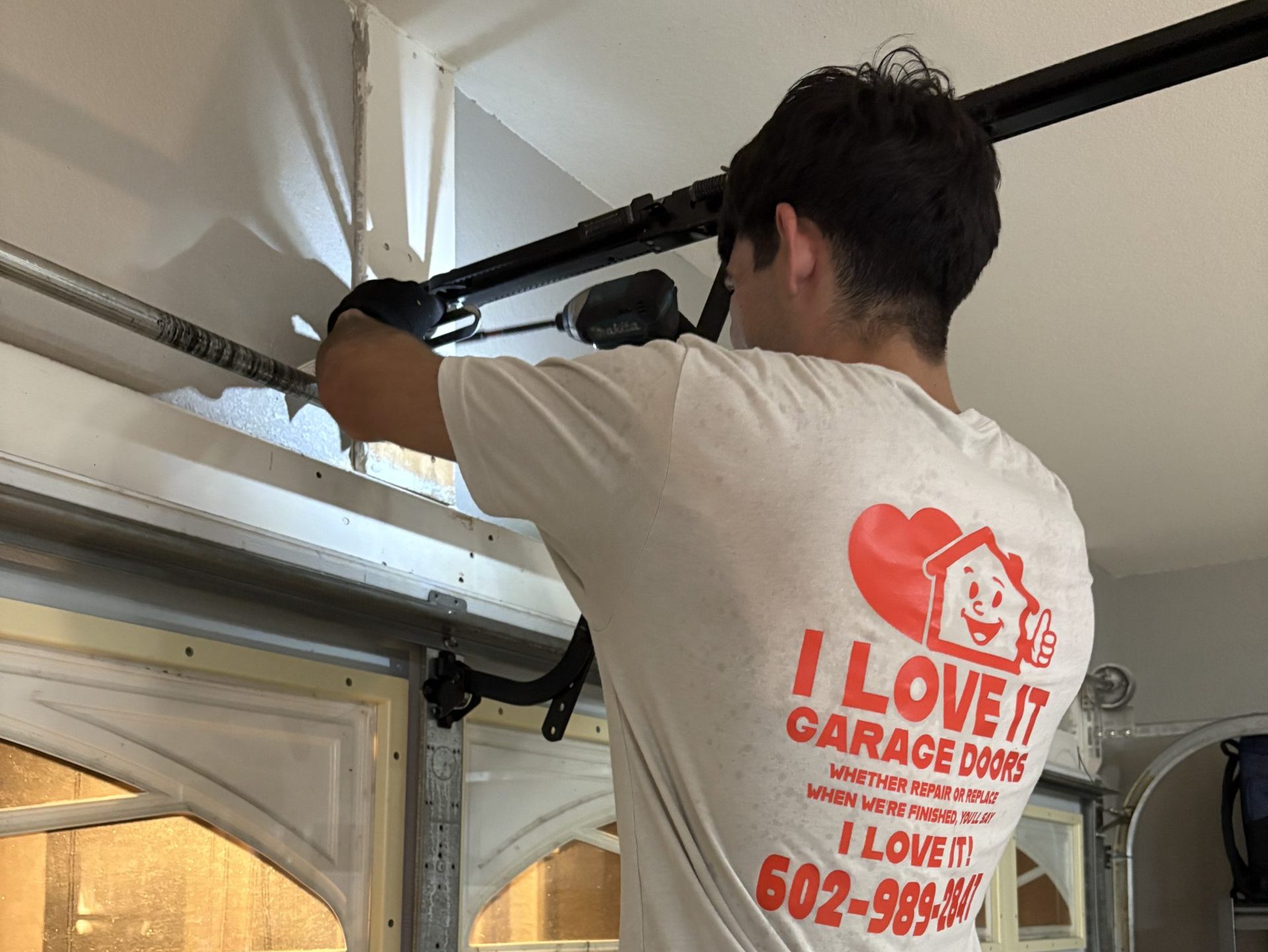
LiftMaster openers are tough machines, but they are part mechanical and part electronic, and the Phoenix heat tests both. Here are the failures we see most often:
Remote or keypad will not work.
Dead battery, lost pairing or a learn-button issue
Motor hums but the door does not move.
A failed capacitor, a stripped gear or a broken spring
Opener runs but the trolley does not engage.
A stripped main gear or a trolley that stayed disconnected
Door will not close or reverses.
Sensors blocked, misaligned or not getting power
Here is a closer look at the problems that show up most on these openers, what usually causes them and how we fix them.
The white plastic main gear is the part most likely to give out on a LiftMaster that has been running for years. When it strips, the motor runs and you hear a whirring or grinding, but the trolley does not move. The trolley, the carriage that connects the rail to the door arm, wears too, and a bent rail can pull the whole drive out of line. We replace gears, trolleys and rail sections as separate parts, so you are not forced into a new opener.
One trick worth knowing: if you pulled the red emergency release cord and the door no longer moves with the opener, the trolley may simply be disconnected. Many openers require pulling the emergency release cord down and back toward the opener, then running the opener until the trolley reconnects. Since opener designs vary, check the owner’s manual if it does not reconnect easily.
Capacitor failure, logic board damage and sensor trouble are the main electrical faults. On openers that use a run capacitor, it is a small part inside the motor head that heat wears out, and when it goes the motor hums but the door does not move. Logic boards can fail from voltage spikes, which are common in monsoon season, and they tend to show up as an opener that ignores the remote and wall control, behaves oddly or has dead lights. We test the motor, board, wall control and sensors before we recommend replacing anything.
A LiftMaster opener repair rarely means a whole new unit. When the board is the issue, we confirm it is the board and not a bad wall control or wire before we swap it, so you only pay for what actually failed.
Our technicians diagnose the opener and recommend the right path: repair when the fix is straightforward, replacement when the unit is at the end of its life. We work on all major brands and stock parts to fix most issues in one visit.
Expert Recommendation
When to Repair or Replace Your LiftMaster
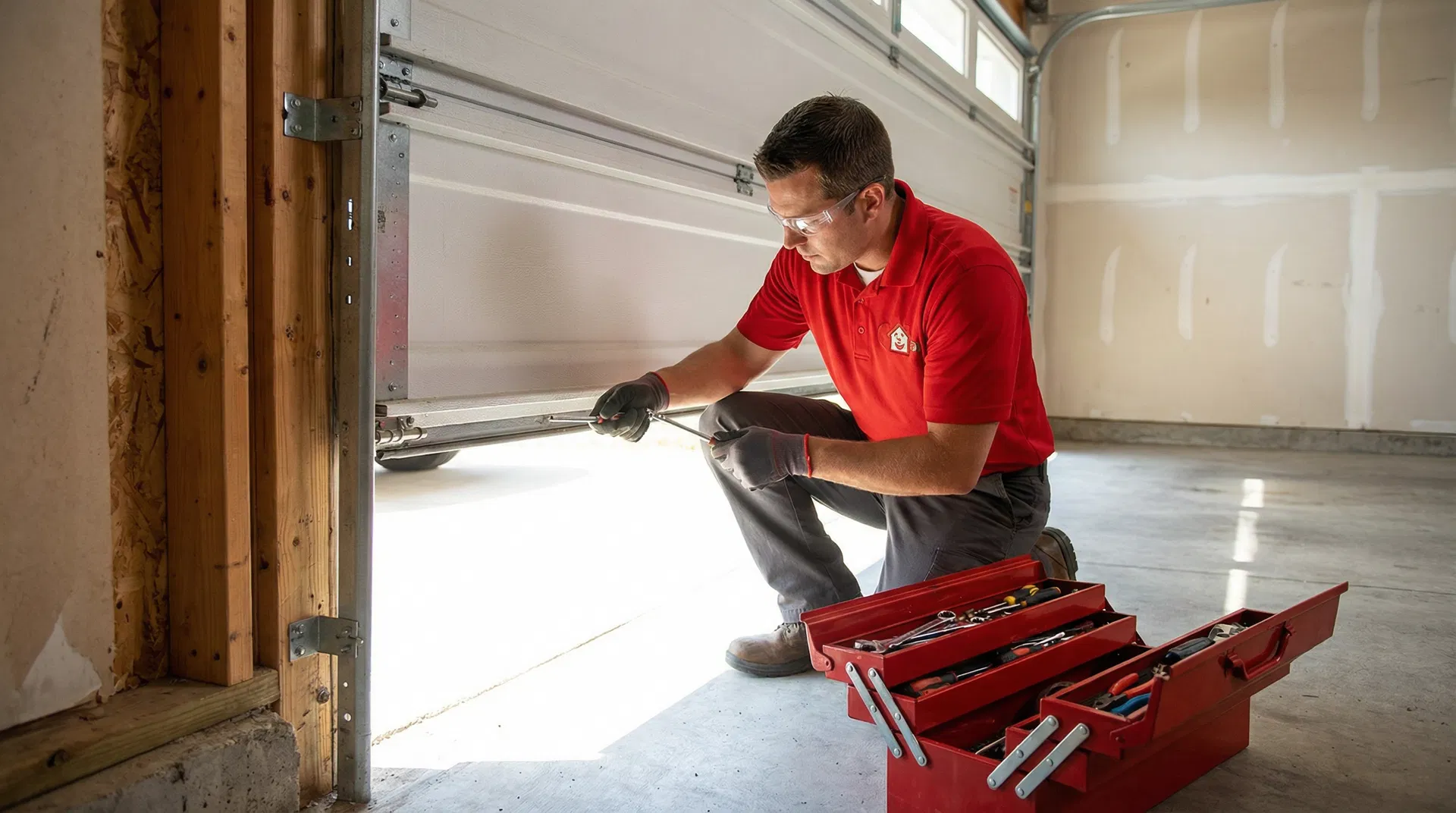
If the opener is fairly young and the failed part is a remote, capacitor, sensor or gear, repair is almost always the right call. If the motor has burned out, or the unit is fifteen years old or more and failing in several places at once, replacement is usually smarter. Newer garage door openers may offer quieter operation, battery backup options, smart controls, and updated safety features. We install them too, and you can read more on our garage door opener installation page.
- Honest assessment. We tell you whether repair or replacement makes more sense for your situation and budget.
- Free diagnosis. You find out what failed before you decide anything.
- Peace of mind. You will know your door closes safely and your family can count on it.
We will never push a replacement when a capacitor or gear swap fixes the problem, and we will be direct if a repair is getting close to what a new opener would cost. The goal is the right call for your home, not the bigger ticket.
Know The Signs
Signs Your LiftMaster Needs Repair
Do not wait for a total failure. These signs mean it is time to call:
Sensor lights. LiftMaster sensors use an amber light and a green light. Both should glow steadily when the eyes are lined up. If a light is dark, dim or flickering, something is blocking the beam, an eye has shifted, a lens is dirty or the wiring has a fault. These sensors affect closing only: the opener may refuse to close the door, or reverse shortly after it starts closing, and on many models the lights on the motor head blink to tell you so.
- Why DIY Opener Repair Can Go Wrong
Some LiftMaster fixes are safe for a homeowner: swapping a remote battery, wiping the sensor lenses, nudging a sensor back into line, or reprogramming a remote. Here is how programming works. Press and release the learn button on the motor head, then press the button on the remote you want to program within about 30 seconds. The learn button comes in different colors, such as yellow, purple, red or orange, and green, depending on the model, and the color tells you which generation of remote technology that opener uses. That is why a remote that works on one opener will not always pair with another. Tap the learn button once, and do not hold it down: holding it until the light goes out erases every remote from the opener.
Anything involving the capacitor, logic board, drive gear or motor means opening the motor head and working near live voltage that can deliver a serious shock, so leave it to a professional.
- Heavy parts falling during disassembly
- Electrical shock inside the motor head
- A door that drops when support is removed incorrectly
- Incorrect reassembly that causes the next failure
A professional has the diagnostic tools, replacement parts and experience to find the failed component on the first visit. A service call usually costs less than guessing at parts and getting it wrong.
Why Choose Us
Why Choose I Love It Garage Doors
Plenty of companies work on garage door openers. Here is what we offer when your LiftMaster acts up:
Same-Day Service
Upfront Pricing
Experienced Technicians
Stocked Trucks
Phoenix Climate
How Arizona Heat Affects LiftMaster Openers
Living in the Valley of the Sun means your opener works in conditions that openers in milder climates never face. A garage can run far hotter than the air outside, and that heat is hard on the electronics:
Capacitors. They are the part most sensitive to heat, which is why a humming motor with a stuck door is a common summer call.
Logic boards. Heat plus monsoon voltage spikes shorten the life of the control board, so we recommend a surge protector on the opener plug.
Remotes and keypads. Batteries run down faster in hot cars and hot garages, so replace them each spring.
Drive gears. Repeated heating and cooling wears the plastic main gear faster.
A little maintenance helps. Wiping dust off the motor head, checking that the door reverses, and replacing batteries each spring catches most heat-related problems before they leave you stuck in the driveway.

LiftMaster Garage Door Opener Repair in Phoenix
Motor, Sensors, Gears and Remotes for LiftMaster
An opener is a motor, a drive system, a logic board and a pair of safety sensors, and Arizona heat is hard on all four. Most calls are a single failed component, so we diagnose before we quote.
- Gear and trolley replacement
- Logic board faults
- Safety sensor alignment
- Remote and keypad programming
- Capacitor replacement
- Belt and chain drive repair
A stripped gear kit is far more common than a burned-out motor on these units. A LiftMaster repair visit usually ends with one new part and a tested door. Chamberlain-branded units share much of the same hardware, and they have their own repair page here. We also fix sensors and remotes, and if you only want a repair, that is what you get. If your opener is a Genie instead, see our Genie opener repair page.
Our Process
Our LiftMaster Repair Process
Here is what to expect when you call:
Tell us what your opener is doing and we will book the earliest appointment we can.
Our tech arrives on time, inspects the opener and door, and explains exactly what is wrong.
You get a free estimate before any work starts, with no surprises.
We complete the repair with quality parts, usually in a single visit.
We test the door and safety sensors several times, then clean up the work area.
Service Areas
Service Areas We Cover
We repair LiftMaster openers throughout the Phoenix metro area, including:
Ready To Get Started?
Get Your LiftMaster Fixed Today
Call I Love It Garage Doors at 602-989-2841, or send us a message, for LiftMaster opener repair across the Phoenix metro area. Our office phones are staffed from 6 AM to 8 PM, seven days a week.
Other Garage Door Services We Offer
Whatever is going on with your garage door, I Love It Garage Doors handles it across the Phoenix Valley: repairs, springs, cables, rollers, panels, openers, new doors, tune-ups and 24 hour emergency calls. Every estimate is free and every repair and install is warrantied.
Got Questions?
Frequently Asked Questions
Have a question we have not answered? Give us a call and we will be glad to help.
Should I repair my LiftMaster opener or replace it?
Are LiftMaster openers the same?
What do the amber and green sensor lights mean?
How do I program a remote to my LiftMaster opener?
My LiftMaster hums but the door does not move. What is it?
My LiftMaster opener stopped working completely. What should I check?
Do you offer emergency LiftMaster opener repair in Phoenix?
How do I reconnect the trolley after using the emergency release?
Can a bad logic board be repaired or does it need replacing?
When is it worth replacing a LiftMaster instead of repairing it?
Got A Garage Door Problem?
We've Got Solutions!
Call us for a free diagnosis, an honest answer on whether your opener can be saved, and a clear plan to get your door working again.
Free Consultation
Get A Free Quote